RiceRat AI addresses Google's focus area of
Stronger Communities, with a secondary
contribution to Scientific Progress through
the practical use of embodied AI, mobile sensing, and
lightweight predictive analytics for agriculture.
This challenge is highly relevant in Vietnam and across
Southeast Asia because agriculture remains dominated by
small-scale producers. In the Asia-Pacific region, family
farmers produce about 80% of the region's
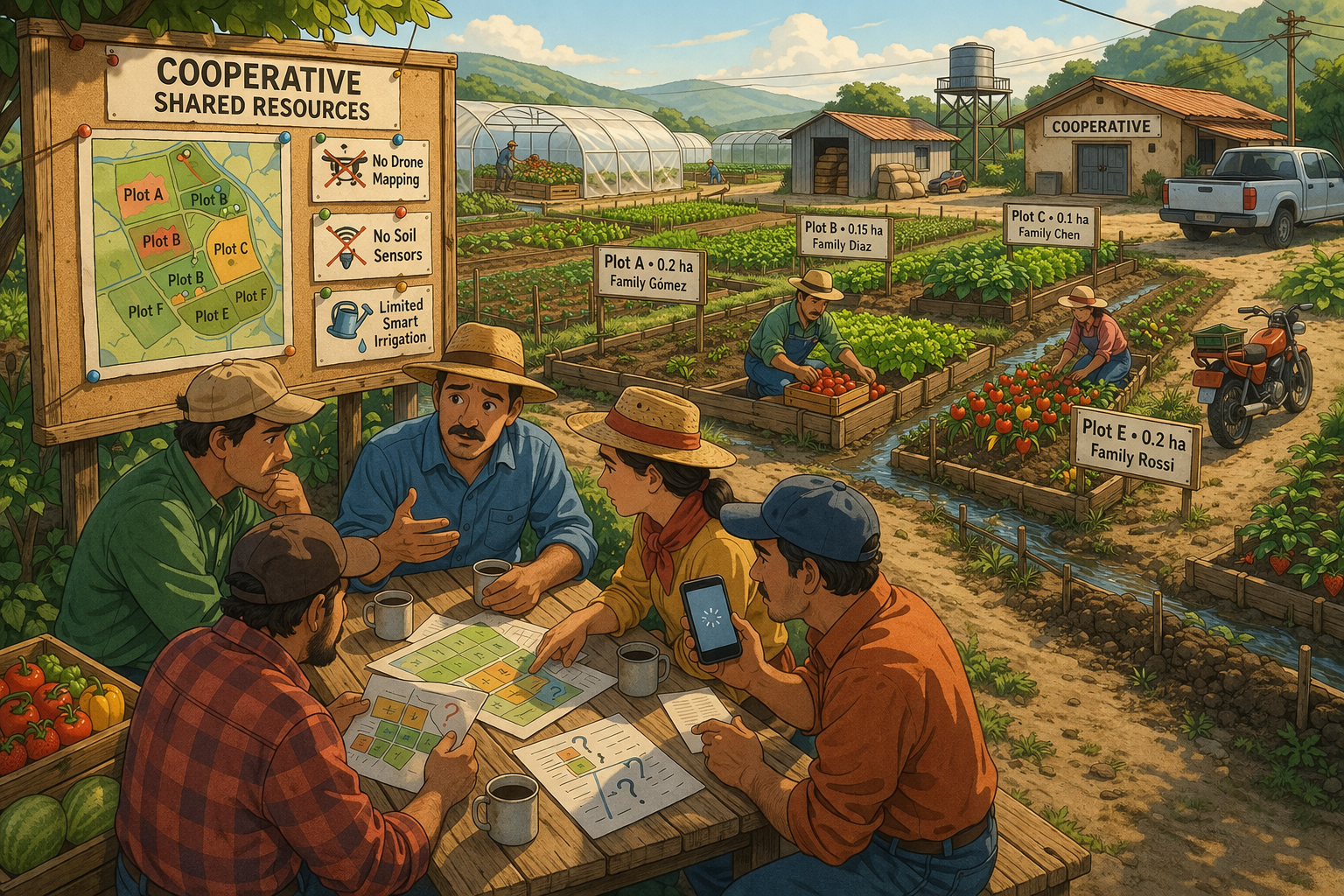
food. In Vietnam, small-scale farms under 0.5 hectares make up
nearly 70% of agricultural landholdings, and
these smaller producers tend to have the lowest access to
digital infrastructure and services [1].
Adoption of smart agriculture remains uneven, especially where
farms are small, resources are limited, and technology must
prove immediate practical value [2, 3]. Lam Dong,
one of Vietnam's most important high-tech agriculture hubs,
had 5,688 hectares of greenhouse area by Q1
2024, yet farmers often still rely on manual crop checking.
Drones are impractical in narrow or covered spaces, while
fixed sensors only capture a few points and miss fine-grained
variation across rows. The challenge is not a lack of
agricultural data, but a lack of
affordable, fine-grained, and actionable monitoring
in small, space-constrained environments. This is precisely
the gap RiceRat AI fills.